



Postulates

Key Concepts
- Use postulates involving points, lines and planes.
- Identify postulates from a diagram.
- Interpret a diagram in three dimensions.
Point, Line and Plane Postulates
POSTULATE 5: Through any two points, there exists exactly one line.
POSTULATE 6: A line contains at least two points.
POSTULATE 7: If two lines intersect, then their intersection is exactly one point.
POSTULATE 8: Through any three non-collinear points, there exists exactly one plane.
POSTULATE 9: A plane contains at least three non-collinear points.

POSTULATE 10: If two points lie in a plane, then the line containing them lies in the plane.
POSTULATE 11: If two planes intersect, then their intersection is a line.
Concept Summary


Perpendicular Figures
A line is a line perpendicular to a plane if and only if the line intersects the plane at a point and is perpendicular to every line in the plane that intersects it at that point.
In a diagram, a line perpendicular to a plane must be marked with a right-angle symbol.

Let’s solve some examples!
Identify a postulate illustrated by a diagram
Example 1:
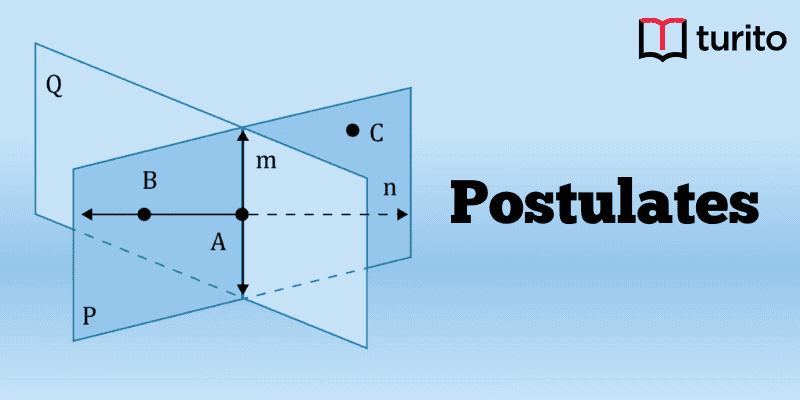
State the postulate illustrated by the diagram.


Solution:
- Postulate 7: If two lines intersect, then their intersection is exactly one point.
- Postulate 11: If two planes intersect, then their intersection is a line.
Identify postulates from a diagram
Example 2:
Use the diagram to write examples of postulates 9 and 10.

Solution:
Postulate 9: Plane P contains at least three non-collinear points, A, B, and C.
Postulate 10: Point A and point B lie in plane P, so line n containing A and B also lies in plane P.
2.3 Use the given information to sketch a diagram
Example 3:

Interpret a diagram in three dimensions
Example 4:

Questions to Solve
Question 1:
State the postulate illustrated by the diagram.

Solution:
- Postulate 5: If there are two points, there exists exactly one line passing through them.
- Postulate 9: If there is a plane, then there are at least three non-collinear points in that plane.
Question 2:
Use the pyramid to write examples of the postulate indicated.

Solution:
- Postulate 5: Only one line SZ passes through the points S and Z.
- Postulate 7: Lines SZ and ZU intersect at only one point Z.
- Postulate 9: Plane formed by the front of this pyramid (it will be called plane STU) contains at least three non-collinear points S, T and U.
- Postulate 10: Points Z and U lie in the plane STU, so the line ZU also lies in plane P.
Question 3:
Decide whether the statement is true or false. If it is false, give a real-world counterexample.
- Through any three points, there exists exactly one line.
- A point can be in more than one plane.
- Any two planes intersect.
Solution:
- False
- Counterexample: If these three points are non-collinear, then one line cannot pass through these three points.
True
False
- Counterexample: If the two planes are parallel, they will never intersect.
Key Concepts Covered
Point, line, and plane postulates
POSTULATE 5: Through any two points, there exists exactly one line.
POSTULATE 6: A line contains at least two points.
POSTULATE 7: If two lines intersect, then their intersection is exactly one point.
POSTULATE 8: Through any three noncollinear points there exists exactly one plane.
POSTULATE 9: A plane contains at least three noncollinear points.
POSTULATE 10: If two points lie in a plane, then the line containing them lies in the plane.
POSTULATE 11: If two planes intersect, then their intersection is a line
Exercise
- In triangle ABC, AD is a median. If the area of ΔABD is 15 cm sq, then find the area of ΔABC.
- ABCD is a parallelogram and BPC is a triangle with P falling on AD. If the area of parallelogram ABCD= 26 cm2, find the area of triangle BPC.
- PQRS is a parallelogram and PQT is a triangle with T falling on RS. If area of triangle
PQT = 18 cm2, then find the area of parallelogram PQRS. - ABCD is a parallelogram where E is a point on AD. Area of ΔBCE = 21 cm2. If CD = 6 cm, then find the length of AF.
- The area of triangle ABC is 15 cm sq. If ΔABC and a parallelogram ABPD are on the same base and between the same parallel lines then what is the area of parallelogram ABPD.
- The area of parallelogram PQRS is 88 cm sq. A perpendicular from S is drawn to intersect PQ at M. If SM = 8 cm, then find the length of PQ.
- Amy needs to order a shade for a triangular-shaped window that has a base of 6 feet and a height of 4 feet. What is the area of the shade?
- Monica has a triangular piece of fabric. The height of the triangle is 15 inches and the triangle’s base is 6 inches. Monica says that the area of the fabric is 90 square inches. What error did Monica make? Explain your answer.
- The sixth-grade art students are making a mosaic using tiles in the shape of right triangle. The two sides that meet to form a right angle are 3 centimeters and 5 centimeters long.
If there are 200 tiles in the mosaic, what is the area of the mosaic? - A parallelogram with area 301 has a base of 35. What is its height?
Related topics

Obtuse Angle: Definition, Degree Measure, and Examples
What is an Obtuse Angle? In geometry, an angle that is greater than 90 degrees but lesser than 180 degrees is called an obtuse angle. We can easily recognize an obtuse angle because it extends past a right angle. Obtuse angle explained in detail with examples but first learn about angles. Type of Angles Geometry […]
Read More >>
Line Segment in Geometry: Definition, Symbol, Formula, and Examples
A line is a straight, one-dimensional figure that extends endlessly in both directions in geometry. It has no starting and ending points. When we define a starting point but not an ending point of a line, it is called a ray. Another important term associated with the line is a line segment. Line Segment Definition […]
Read More >>Area of Irregular Shapes for Grade 3 – Simple Methods & Examples
What Is the Area of an Irregular Shape? The area of an irregular shape is the space that it occupies, although it does not follow a clean formula. In contrast to the squares or perfect rectangles, irregular shapes have sides that are uneven or their angles don’t line up evenly. That is what makes them […]
Read More >>
Addition and Multiplication Using Counters & Bar-Diagrams
Introduction: We can find the solution to the word problem by solving it. Here, in this topic, we can use 3 methods to find the solution. 1. Add using counters 2. Use factors to get the product 3. Write equations to find the unknown. Addition Equation: 8+8+8 =? Multiplication equation: 3×8=? Example 1: Andrew has […]
Read More >>

Other topics



Comments: