



Prime and Composite Numbers, & Multiples

Key Concepts
- Prime numbers
- Composite numbers
Prime and Composite Numbers, Multiples
Prime number:
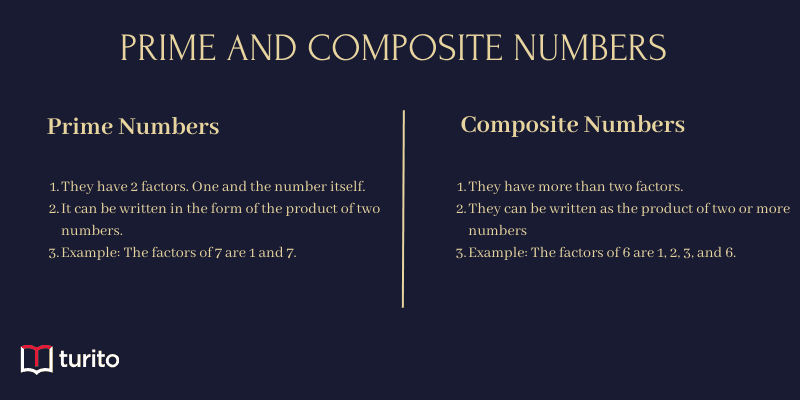
A prime number is a whole number greater than 1 that has exactly two factors, 1 and itself.

13 can only be factorized as follows:
1 × 13 = 13
13 × 1 =13
13 groups of 1

1 group of 13
This means 1 and 13 are the only factors of 13.
So, 13 is a prime number because it could not be divided into groups of equal numbers.

Composite number:
A composite number is a number greater than 1 that has more than two factors.
For example, 12 can be factorized in multiple ways.
So, the factors of 12 are 1, 2, 3, 4,6 and 12.
It has more than two factors. Therefore, 12 is a composite number.
7.2.1 Prime numbers

A prime number is a whole number greater than 1 that has exactly two factors, 1 and itself.
Example1:
Robert has 7 balls. Can he group the balls in more than two ways?
Solution:
7 is a prime number.


The number 1 is a special number. It is neither prime nor composite.
7 is a prime number.
So, he cannot group the balls in more than two ways.
Example2:
Ria has 11 balloons to decorate the room. Ria says, “I have prime number of balloons” is she correct? Explain.

Solution:
11 is a prime number.


7.2.2 Composite numbers
A composite number is a number greater than 1 that has more than two factors.
Example1:
The image shows 8 books. What are the factors for 8?

Solution:
8 is a composite number.


So, 8 is a composite number.
Example2:
Mart wants to buy 4 caps. Tell whether 4 is a prime or composite number.

Solution:
4 is a composite number.


Exercise
- John has 49 pencils. Can he group the pencils in more than two ways?
- Tell whether each number is prime or composite.
- 23
- 34
- 45
- How many composite numbers are there between 1 to 50?

- Circle the prime numbers.
- List out the factors of a number and write whether the number is prime or composite.
- 47 Factors are _______________
- Is 47 is prime or composite? ______________.
- What is the fifth prime number?
- Find two prime numbers that add up to 52.
- How many composite numbers are there between 50 to 80?
- Routh says the product of two composite numbers must also be composite. Joan disagreed. Who is correct?
- List out the factors of a number and write whether the number is prime or composite

Concept map:

What have we learned:
- Understand prime numbers.
- Understand composite numbers.
- Finding factors for prime numbers.
- Finding factors for composite numbers.
- Identify the prime numbers and composite numbers.
Related topics

Obtuse Angle: Definition, Degree Measure, and Examples
What is an Obtuse Angle? In geometry, an angle that is greater than 90 degrees but lesser than 180 degrees is called an obtuse angle. We can easily recognize an obtuse angle because it extends past a right angle. Obtuse angle explained in detail with examples but first learn about angles. Type of Angles Geometry […]
Read More >>
Line Segment in Geometry: Definition, Symbol, Formula, and Examples
A line is a straight, one-dimensional figure that extends endlessly in both directions in geometry. It has no starting and ending points. When we define a starting point but not an ending point of a line, it is called a ray. Another important term associated with the line is a line segment. Line Segment Definition […]
Read More >>Area of Irregular Shapes for Grade 3 – Simple Methods & Examples
What Is the Area of an Irregular Shape? The area of an irregular shape is the space that it occupies, although it does not follow a clean formula. In contrast to the squares or perfect rectangles, irregular shapes have sides that are uneven or their angles don’t line up evenly. That is what makes them […]
Read More >>
Addition and Multiplication Using Counters & Bar-Diagrams
Introduction: We can find the solution to the word problem by solving it. Here, in this topic, we can use 3 methods to find the solution. 1. Add using counters 2. Use factors to get the product 3. Write equations to find the unknown. Addition Equation: 8+8+8 =? Multiplication equation: 3×8=? Example 1: Andrew has […]
Read More >>

Other topics





Comments: