



Prisms and Cylinders

Key Concepts
- Use the net of a prism.
- Find the surface area of a right prism.
- Find the surface area of a cylinder.
- Find the height of a cylinder.
Introduction
Prism
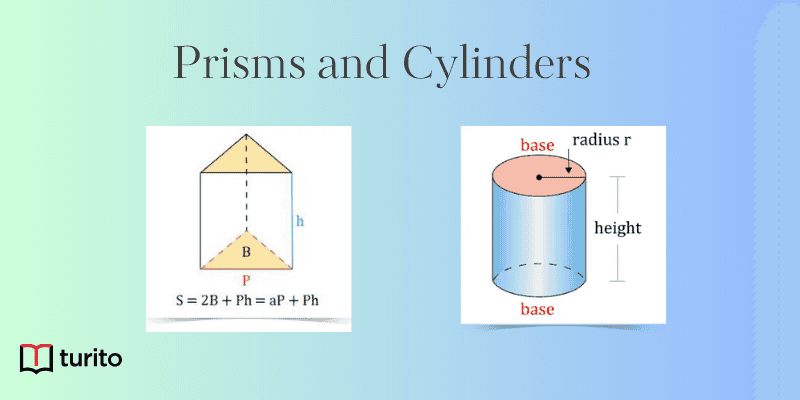
Prism is a polyhedron with two congruent faces, called bases, that lie in parallel planes.
Lateral faces
All faces other than the bases; are parallelograms formed by connecting the corresponding vertices of the bases.
Lateral edges
Segments connecting the vertices of the bases and lateral faces.
Surface area: (of a polyhedron)
Sum of the areas of its faces.
Lateral area: (of a polyhedron)
Sum of the area of its lateral faces.

Net: Two-dimensional representation of the faces.
Right prism: Each lateral edge is perpendicular to both bases.

Oblique prism: Lateral edges are not perpendicular to the bases.

Use the net of a prism
Example 1:
Find the surface area of a rectangular prism with a height of 3 inches, length 7 inches, and width 4 inches using a net.
Solution:
Step 1: Sketch the prism. Imagine unfolding it to make a net.

STEP 2: Find the areas of the rectangles that form the faces of the prism.

STEP 3: Add the areas of all the faces to find the surface area.
The surface area of the prism is S = 2(21) + 2(12) + 2(28) = 122 inch2.
Find the surface area of a right prism
The surface area of a prism is
- S = Ph + 2B, where
- P = perimeter of the base
- h = height
- B = area of the base

Example 2:
Find the surface area of a right rectangular prism with a height of 3 inches, length 7 inches, and width 4 inches using the formula for the surface area of a right prism.

Solution:
Surface area = 2B + Ph
B = 7 × 4 = 28
P = 2L + 2W
= 2(7) + 2(4)
= 22
h = 3
S.A = 2(28) + 22(3)
= 122 inch2
Find the surface area of a cylinder
Cylinder: Solid with congruent circular bases that lie in parallel planes. The height is the perpendicular distance between its bases. The radius of a base is the radius of the cylinder.
Right cylinder: The segment joining the centers of the bases is perpendicular to the bases.
Lateral Surface Area: The lateral area of a cylinder is the area of its curved surface. It is equal to the product of the circumference and the height, or 2πrh.
Surface Area: The surface area of a cylinder is equal to the sum of the lateral area and the areas of the two bases.


Example 3:
Find the surface area of the right cylinder.

Solution:
S = 2πr2 + 2πrh (Formula for surface area of a cylinder)
= 2π(32) + 2π(3)(4) (Substitute known values)
= 18π + 24π (Simplify)
= 42π
= 131.88 (Use a calculator)
The surface area is about 131.88 square feet.
Find the height of a cylinder
Example 4:
Find the height of a cylinder that has a radius of 6.5 centimeters and a surface area of 592.19 square centimeters.

Solution:
Substitute known values in the formula for the surface area of a right cylinder and solve for the height h.
S = 2πr2 + 2πrh (Surface area of a cylinder)
592.19 = 2π(6.5)2 + 2π(6.5)h (Substitute known values)
592.19 = 265.33+ 13πh (Simplify)
592.19 – 265.33 = 13πh (Subtract 265.33 from each side)
326.86 = 40.82h (Simplify. Use a calculator)
8 ≈ h (Divide each side by 40.82)
The height of the cylinder is about 8 centimeters.
Exercise
- The surface area of a polyhedron is the sum of the areas of its _____________.
- The lateral area of a polyhedron is the sum of the areas of its ______________________.
- Find the height of the right cylinder shown, which has a surface area of 157.08 square meters.

- Find the surface area of a box of cereal with a height of 15 inches, a length of 8 inches, and a width of 4 inches.
- Find the surface area of a right rectangular prism with a height of 8 inches, a length of 3 inches, and a width of 5 inches.
- Find the lateral area and surface area of the cylinder below.

- Find the surface area of the figure below.

- Find the lateral and surface area of the figure below.

- Draw a net of a triangular prism.
- You are wrapping a stack of 20 compact discs using a shrink wrap. Each disc is cylindrical with a height of 1.2 millimeters and a radius of 60 millimeters. What is the minimum amount of shrink wrap needed to cover the stack of 20 discs?
Concept Map

What have we learned
- Use the net of a prism to find the surface area.
- Find the surface area of a right prism by using the formula.
- Find the surface area of a cylinder by using the formula.
- Find the height of a cylinder by using the formula.
Related topics

Obtuse Angle: Definition, Degree Measure, and Examples
What is an Obtuse Angle? In geometry, an angle that is greater than 90 degrees but lesser than 180 degrees is called an obtuse angle. We can easily recognize an obtuse angle because it extends past a right angle. Obtuse angle explained in detail with examples but first learn about angles. Type of Angles Geometry […]
Read More >>
Line Segment in Geometry: Definition, Symbol, Formula, and Examples
A line is a straight, one-dimensional figure that extends endlessly in both directions in geometry. It has no starting and ending points. When we define a starting point but not an ending point of a line, it is called a ray. Another important term associated with the line is a line segment. Line Segment Definition […]
Read More >>Area of Irregular Shapes for Grade 3 – Simple Methods & Examples
What Is the Area of an Irregular Shape? The area of an irregular shape is the space that it occupies, although it does not follow a clean formula. In contrast to the squares or perfect rectangles, irregular shapes have sides that are uneven or their angles don’t line up evenly. That is what makes them […]
Read More >>
Addition and Multiplication Using Counters & Bar-Diagrams
Introduction: We can find the solution to the word problem by solving it. Here, in this topic, we can use 3 methods to find the solution. 1. Add using counters 2. Use factors to get the product 3. Write equations to find the unknown. Addition Equation: 8+8+8 =? Multiplication equation: 3×8=? Example 1: Andrew has […]
Read More >>

Other topics



Comments: