



Four Properties of Equality with Examples

Key Concepts
• Determine properties of equality.
• Apply multiplication and division properties of equality.
• Apply addition and subtraction properties of equality.
4.2 Apply Properties of Equality
Introduction:
An equation is a mathematical sentence that uses an equal sign to show that two expressions are equal. An equation is true when both sides are equal.
For example,

5 + 4 =9 is an equation.

Keep an Equation balanced:
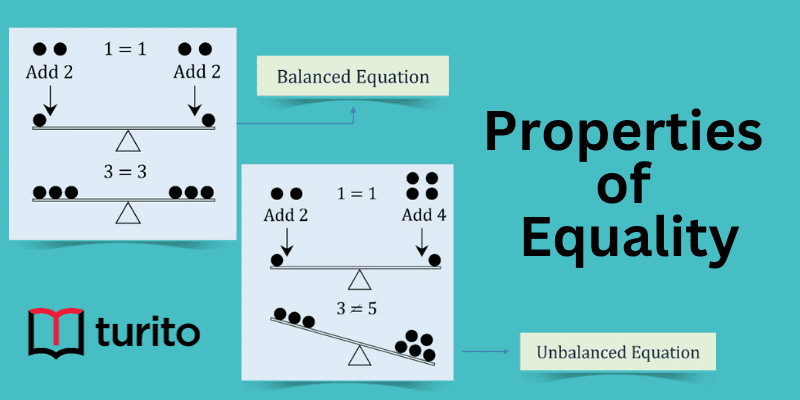
To keep an equation balanced, you must do the same thing to each side.


4.2.1 Determine properties of equality
Addition property of equality:
The addition property of equality states that the two sides of an equation stay equal when the same amount is added to both sides of the equation.
For example,
5 + 4 =9 is an equation.
If you add 2 on both sides,
(5+4)+2 = 9+2 is still an equation because two sides will still be equal.
Subtraction property of equality:
The subtraction property of equality states that the two sides of an equation stay equal when the same amount is subtracted from both sides of the equation.
For example,
5 + 4 =9 is an equation.
If you subtract with 2 on both sides,
(5+4) – 2 = 9 – 2 is still an equation because two sides will still be equal.
Multiplication property of equality:
The multiplication property of equality states that when you multiply both sides of the equation by the same amount, the two sides of an equation stay equal.
For example,
5 + 4 =9 is an equation.
If you multiply with 2 on both sides,
(5+4) × 2 = 9 × 2 is still an equation because two sides will still be equal.
Division property of equality:
The division property of equality states that when you divide both sides of the equation by the same non-zero amount, the two sides of an equation stay equal.
For example,
5 + 4 =9 is an equation.
If you divide by 3 on both the sides,
(5+4) ÷ 3 = 9 ÷ 3 is still an equation because two sides will still be equal.
4.2.2 Apply multiplication and division properties of equality
Example 1:
This scale is balanced with 3 green blocks on one side and 1 blue x-block on the other side. Franklin added some more green blocks on the right side and now the scale is not balanced. What can you do to make the scale balance?

Solution:
Multiply the right side of the balance by 5 to balance the scale.
x = 3
5 . x = 3 . 5
Example 2:
Judy says, “You can multiply each side of the equation x – 5 = 15 with 2 and the equation will still be true.”
Rachel says, “You can divide each side of the equation x – 5 = 15 by 3 and the equation will still be true.”
Who is correct? Explain.

4.2.3 Apply addition and subtraction properties of equality
Example 3:
Judy says, “You can add 14 to each side of the equation x – 10 = 25 and the equation will still be true.”
Rachel says, “You can subtract 3 from each side of the equation x – 10 = 25 and the equation will still be true.”
Who is correct? Explain.


Exercise:
1. Evaluate the equation, 1116 + 5 = 21, does 16 + 5 – 4 = 21 – 4? Why or why not?
2. Evaluate the equation, 113p = 27, does 3p x 2 = 27 x 3? Why or why not?
3. Evaluate the equation, 114s – 6 = 18, does (4s – 6) + 2 = 18 + 2? Why or why not?
4. A pan balance shows x + 3 = 10. If you add 4 units to one side, can you balance the scale by adding x units to the other side? Explain.
5. Evaluate the equation, If 12 – 8 = 4, does (12 -8) + 2 = 4 x 2? Explain.
6. A pan balance shows 8 + S = 13. If 4 units are removed from one side, what needs to be done to the other side to keep the pans balanced?
7. Apply the Multiplication Property of Equality to write an equation equivalent to 6n= 24.
8. Jaden says that if one side of the equation Gm = 9 is divided by 2, and the other side is divided by 3, the equation will stay equal because the result will be 3m = 3. Is laden correct? Explain.
9. Tell which property of equality was used. Sm + 4 =10 Sm+ 4 -3= 10-3
10. If 7w = 56, which property of equality was used to find the equivalent equation 7w + 7 = 56 + 7?
What have we learned:
• Use properties of equality to write equivalent equations.
• Apply multiplication and division properties of equality to write equivalent equations.
• Apply addition and subtraction properties of equality to write equivalent equations.
Related topics

Obtuse Angle: Definition, Degree Measure, and Examples
What is an Obtuse Angle? In geometry, an angle that is greater than 90 degrees but lesser than 180 degrees is called an obtuse angle. We can easily recognize an obtuse angle because it extends past a right angle. Obtuse angle explained in detail with examples but first learn about angles. Type of Angles Geometry […]
Read More >>
Line Segment in Geometry: Definition, Symbol, Formula, and Examples
A line is a straight, one-dimensional figure that extends endlessly in both directions in geometry. It has no starting and ending points. When we define a starting point but not an ending point of a line, it is called a ray. Another important term associated with the line is a line segment. Line Segment Definition […]
Read More >>Area of Irregular Shapes for Grade 3 – Simple Methods & Examples
What Is the Area of an Irregular Shape? The area of an irregular shape is the space that it occupies, although it does not follow a clean formula. In contrast to the squares or perfect rectangles, irregular shapes have sides that are uneven or their angles don’t line up evenly. That is what makes them […]
Read More >>
Addition and Multiplication Using Counters & Bar-Diagrams
Introduction: We can find the solution to the word problem by solving it. Here, in this topic, we can use 3 methods to find the solution. 1. Add using counters 2. Use factors to get the product 3. Write equations to find the unknown. Addition Equation: 8+8+8 =? Multiplication equation: 3×8=? Example 1: Andrew has […]
Read More >>

Other topics


Comments: