



Properties of Trapezoids

Key Concepts
- Define a trapezoid.
- Explain the properties of a trapezoid.
- Solve problems based on properties of a kite.
Trapezoid
A quadrilateral having only one pair of parallel sides is called a trapezoid.

- A trapezium in which the non-parallel sides are equal is an isosceles trapezium.

Property of a trapezoid related to base angles
Theorem 1:
In an isosceles trapezoid, each pair of base angles is congruent.

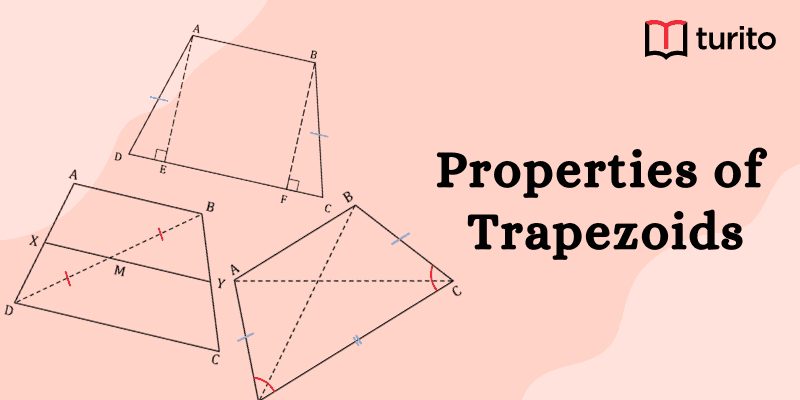
Given: ABCD is a trapezoid where AB∥CD.
To prove: ∠ADC = ∠BCD and ∠BAD = ∠ABC
Proof:

Draw perpendicular lines AE and BF between the parallel sides of the trapezoid.
In ΔAED and ΔBFC,
AD = BC [Isosceles trapezoid]
AE = BF [Distance between parallel lines will always be equal]
∠AEB = ∠BFC=90° [AEꞱCD and BFꞱCD]
If two right-angled triangles have their hypotenuses equal in length and a pair of shorter sides are equal in length, then the triangles are congruent.
∴ ΔAED ≌ ΔBFC [RHS congruence rule]
We know that the corresponding parts of congruent triangles are equal.
Hence, ∠ADC = ∠BCD
And ∠EAD = ∠FBC
Now, ∠BAD = ∠BAE + ∠EAD
∠BAD = 90° + ∠EAD
∠BAD = 90° + ∠EAD
∠BAD = ∠ABC
Hence, each pair of base angles of an isosceles trapezoid is congruent.
Property of trapezoid related to the length of diagonals
Theorem 2:
The diagonals of an isosceles trapezoid are congruent.

Given: In trapezoid ABCD, AB∥CD, and AD = BC
To prove: AC = BD
Proof:
In ΔADC and ΔBCD,
AD = BC [Isosceles trapezoid]
∠ADC = ∠BCD [Base angles of isosceles trapezoid]
CD = CD [Common]
Therefore, ΔAED ≌ ΔBFC [SAS congruence rule]
We know that the corresponding parts of congruent triangles are equal.
So, AC = BD
Hence, the diagonals of an isosceles trapezoid are congruent.
Property of trapezoid related to the length of diagonals
Theorem 3:
In a trapezoid, the midsegment is parallel to the bases, and the length of the midsegment is half the sum of the lengths of the bases.

Given: In trapezoid ABCD, AB∥CD, and X is the midpoint of AD, Y is the midpoint of BC.
To prove: XY = 1/2 × (AB+CD)
Proof: Construct BD such that the midpoint of BD passes through XY.
In ΔADB, X is the midpoint of AD, and M is the midpoint of DB.
So, XM is the midsegment of ΔADB.
We know that a line segment joining the midpoints of two sides of the triangle is parallel to the third side and has a length equal to half the length of the third side. [Midsegment theorem]
∴ XM ∥ AB and XM = 1/2 × AB …(1)
In ΔBCD, Y is the midpoint of BC and M is the midpoint of BD.
So, MY is the midsegment of ΔBCD.
∴ MY ∥ CD and MY = 1/2 × CD …(2) [Midsegment theorem]
Since XM ∥ AB and MY ∥ CD, so, XY
Now, XY=XM+MY
= 1/2 × AB + 1/2 × CD
XY = 1/2 × (AB+CD)
Kite
A kite is a quadrilateral whose four sides can be grouped into two pairs of equal-length sides that are adjacent to each other.
(or)
A parallelogram also has two pairs of equal-length sides, but they are opposite each other in a kite.

- Only one diagonal of a kite bisects the other diagonal.
Property of kite related to the angle between the diagonals
Theorem:
The diagonals of a kite are perpendicular.

Given: In kite WXYZ, XY=YZ, WX=ZW
To prove: XZ Ʇ WY
Proof: Draw diagonals XZ and WY. Let the diagonals intersect at O.
In ΔWXY and ΔWZY,
WX=WZ [Adjacent sides of kite]
XY=ZY [Adjacent sides of kite]
WY=YW [Reflexive property]
∴ ΔWXY ≌ ΔWZY [SSS congruence rule]
We know that the corresponding parts of congruent triangles are equal.
So, ∠XYW= ∠ZYW …(1)
In ΔOXY and ΔOZY,
XY=ZY [Adjacent sides of kite]
OY=YO [Reflexive property]
∠XYW= ∠ZYW [from (1)]
∴ ΔOXY ≌ ΔOZY [SAS congruence rule]
So, ∠YOX = ∠YOZ [CPCT]
But ∠YOX+∠YOZ = 180°
2∠YOX = 180°
∠YOX = 90°
Hence, the diagonals of a kite are perpendicular.
Exercise
- Find the value of k if STUV is a trapezoid.

- If EFGH is an isosceles trapezoid, find the value of p.

- Find the length of PQ if LMQP is a trapezoid and O is the midpoint of LP and N is the midpoint of MQ.

- What must be the value of m if JKLM is a kite?

- If WXYZ is a kite, find the length of diagonal XZ.

Concept Map

What we have learned
- A quadrilateral having only one pair of parallel sides is called a trapezoid.
- A kite is a quadrilateral whose four sides can be grouped into two pairs of equal-length sides that are adjacent to each other.
Related topics

Obtuse Angle: Definition, Degree Measure, and Examples
What is an Obtuse Angle? In geometry, an angle that is greater than 90 degrees but lesser than 180 degrees is called an obtuse angle. We can easily recognize an obtuse angle because it extends past a right angle. Obtuse angle explained in detail with examples but first learn about angles. Type of Angles Geometry […]
Read More >>
Line Segment in Geometry: Definition, Symbol, Formula, and Examples
A line is a straight, one-dimensional figure that extends endlessly in both directions in geometry. It has no starting and ending points. When we define a starting point but not an ending point of a line, it is called a ray. Another important term associated with the line is a line segment. Line Segment Definition […]
Read More >>Area of Irregular Shapes for Grade 3 – Simple Methods & Examples
What Is the Area of an Irregular Shape? The area of an irregular shape is the space that it occupies, although it does not follow a clean formula. In contrast to the squares or perfect rectangles, irregular shapes have sides that are uneven or their angles don’t line up evenly. That is what makes them […]
Read More >>
Addition and Multiplication Using Counters & Bar-Diagrams
Introduction: We can find the solution to the word problem by solving it. Here, in this topic, we can use 3 methods to find the solution. 1. Add using counters 2. Use factors to get the product 3. Write equations to find the unknown. Addition Equation: 8+8+8 =? Multiplication equation: 3×8=? Example 1: Andrew has […]
Read More >>

Other topics



Comments: