



Pyramids and Cones Surface Area

Key Concepts
- Find the area of a lateral face of a pyramid.
- Find the surface area of a pyramid.
- Find the lateral area of a cone.
Introduction
Regular Pyramid
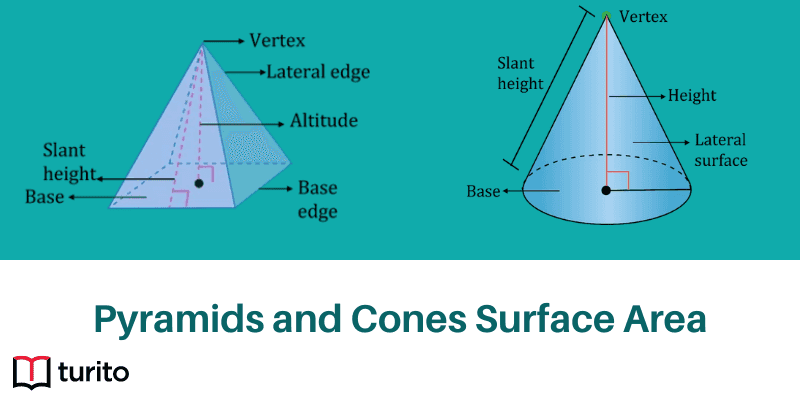
A regular pyramid has a base that is a regular polygon, and the altitude has an endpoint at the center of the base.

Lateral Faces
Faces that meet at the vertex. In a regular pyramid, they are all congruent isosceles triangles.
Vertex
The point where the lateral faces meet.
Nonregular Pyramid

Lateral Edge
The intersection of two lateral faces. All the lateral edges are congruent in a regular pyramid.
Slant Height
The height of each lateral face, ℓ.

Find the area of a lateral face of a pyramid
Example 1:
The lateral faces of the Pyramid Arena in Memphis, Tennessee, are covered with steel panels. Use the diagram of the arena to find the area of each lateral face of this regular pyramid.


Solution:
Use the Pythagorean Theorem to find the slant height of the pyramid.

(Slant height)2 = h2 + ( 1/2 s)2 (Write formula)
(Slant height)2 = 3212 + 1502 (Substitute for h and 1/2s)
(Slant height)2 = 125,541 (Simplify)
Slant height = √125,541 (Write formula)
Slant height ≈ 354.32 (Find the positive square root)
So, the area of each lateral face is 1/2
(base of the lateral face) (slant height), or about
1/2(300) (354.32).
That is about 53,148 square feet.
Find the surface area of a pyramid
Example 2:
Find the surface area of a regular pyramid shown.

Solution:
To find the surface area of the regular pyramid shown, start by finding the area of the base.
Use the formula for the area of a regular polygon, 1/2(apothem)(perimeter). A diagram of the base is shown in the following picture.

After substituting, the area of the base is 1/2(3√3)(6 × 6) = 54√3 square meters.
Now we can find the surface area by using 54√3 for the area of the base, B.
S = B + 1/2
Pl à Formula for the surface area of a regular pyramid
= 54√3 + 1/2 (36)(8) (Substitute known values)
= 54√3 + 144 (Simplify)
≈ 237.5 (Use a calculator)
The surface area of the regular pyramid is about 237.5 m2.
Find the lateral area of a cone
Cone
A circular cone, or cone, has a circular base and a vertex that is NOT in the same plane as the base. The altitude or height is the perpendicular distance between the vertex and the base.
Right cone
In a right cone, the height meets the base at its center, and the slant height is the distance between the vertex and a point on the base edge.

Slant height of a right cone
The distance between the vertex and a point on the edge of the base.
Surface Area of a Right Cone
The surface area S of a right cone is S = pr2 + prl, where r is the radius of the base and l is the slant height.
Lateral surface area
The lateral surface of a cone consists of all segments that connect the vertex with points on the base edge.

Example 3:
Find the lateral area of the following cone.

Solution:
To find the slant height l, use the Pythagorean Theorem.
l 2 = 122 + 52, so l = 13 ft.
Find the lateral area.
Lateral area = πrl (Write formula)
= π(5)(13) (Substitute known values)
= 204.1 (Simplify and use a calculator)
The lateral area of the cone is about 204.1 square feet.
Exercise
- __________________ is a polyhedron with one base.
- Find the slant height of the right cone.

- Name the figure that is represented by the net. Then find its surface area and round the result to one decimal place.

- Find the surface area of the following cone.

Ans: The surface area is 40p square inches or about 125.7 square inches.
- Find the lateral area of a right cone with a radius of 9 cm and a slant height of 5 cm.
- Find the surface area of a right cone with a radius of 9 cm and a slant height of 5 cm.
- Find the lateral area of each lateral face of the regular pyramid. Then find the surface area of the pyramid.

- Find the surface area of the regular shape.

- Find the surface area of the regular shape.

- The Great Pyramid of Giza is a regular square pyramid. It is estimated that when the pyramid was first built, each base edge was 230.4 meters long, and the slant height was 186.4 meters long. Find the lateral area of a square pyramid with those dimensions.

Concept Map

What have we learned
- Find the area of a lateral face of a pyramid using the formula.
- Find the surface area of a pyramid using the formula.
- Find the lateral area of a cone using the formula.
Related topics

Obtuse Angle: Definition, Degree Measure, and Examples
What is an Obtuse Angle? In geometry, an angle that is greater than 90 degrees but lesser than 180 degrees is called an obtuse angle. We can easily recognize an obtuse angle because it extends past a right angle. Obtuse angle explained in detail with examples but first learn about angles. Type of Angles Geometry […]
Read More >>
Line Segment in Geometry: Definition, Symbol, Formula, and Examples
A line is a straight, one-dimensional figure that extends endlessly in both directions in geometry. It has no starting and ending points. When we define a starting point but not an ending point of a line, it is called a ray. Another important term associated with the line is a line segment. Line Segment Definition […]
Read More >>Area of Irregular Shapes for Grade 3 – Simple Methods & Examples
What Is the Area of an Irregular Shape? The area of an irregular shape is the space that it occupies, although it does not follow a clean formula. In contrast to the squares or perfect rectangles, irregular shapes have sides that are uneven or their angles don’t line up evenly. That is what makes them […]
Read More >>
Addition and Multiplication Using Counters & Bar-Diagrams
Introduction: We can find the solution to the word problem by solving it. Here, in this topic, we can use 3 methods to find the solution. 1. Add using counters 2. Use factors to get the product 3. Write equations to find the unknown. Addition Equation: 8+8+8 =? Multiplication equation: 3×8=? Example 1: Andrew has […]
Read More >>

Other topics





Comments: