



Quadratic Equations Using Graphs and Tables

Key Concepts
- Solve quadratic equations using tables
- Solve quadratic equations using graphs
- Discriminant and intersection of graphs
Introduction
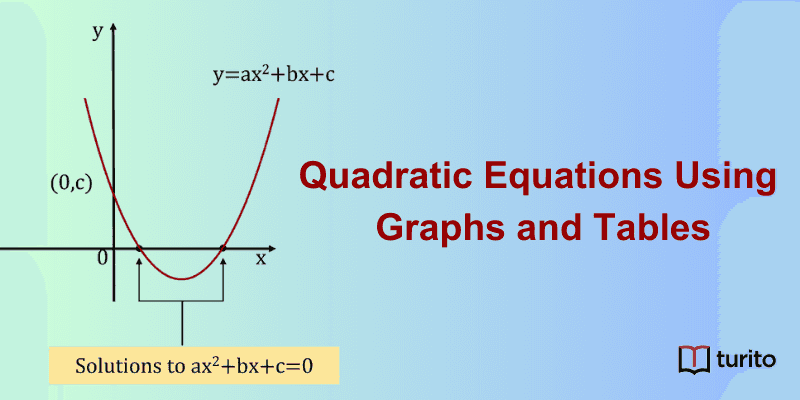
A quadratic equation of the form ax2 + bx + c = 0 can also be represented as y = ax2 + bx + c.
The graph y = ax2 + bx + c, is in the form of a parabola used to locate the solutions or roots of the quadratic equation.
Solving Quadratic Equation graphically
Here, the graph is y = ax2 + bx + c, which forms a parabola.
The parabola intersects the x-axis at two points, which are called roots or solutions.
The parabola intersects the y-axis at one point, which is constant c.


To draw the graph given in the figure, firstly, we construct a table with x values and y values.
We assume x values, and we find the y values to draw the graph.

Two Solutions Quadratic Equation
Example 1:
Determine the solutions of the quadratic equation x2+2x−4=0
by using graphs. Give answers to 1 decimal place where appropriate.
Firstly, construct a table for y = x2+2x−4.


Now, by the table, we have drawn the graph and plotted the points,
The graph cuts the x-axis(y=0) at x = 1.23 and x = -3.23
So, from the graph the solutions are x = 1.23 and x = -3.23
Example 2:
Determine the solutions of the quadratic equation x2−7x+12=0
by using graphs. Give answers to 1 decimal place where appropriate.
Firstly, construct a table for y = x2−7x+12.


Now, by the table, we have drawn the graph and plotted the points,
The graph cuts the x-axis(y=0) at x = 3 and x = 4.
So, from the graph the solutions are x = 3 and x = 4.
One solution Quadratic Equations
- In general, the quadratic equation will have two solutions, but there are some special cases where the quadratic equation has only one solution, and some have no solutions.
- Some quadratic equations have only one solution.
- For example, 𝒙𝟐−𝟐𝒙+𝟏=𝟎, 𝒙𝟐−𝟔𝒙+𝟗=𝟎.
- Let us see some examples with one solution.
Example 1:
Draw the graph for 𝒚 = 𝒙𝟐−𝟐𝒙+𝟏 𝒂𝒏𝒅 find the solutions for the quadratic equations.
Firstly, construct a table with x and y values.


Now, by the table, we have drawn the graph and plotted the points,
The graph cuts the x-axis(y=0) at x = 1.
So, from the graph, there is only one solution as the graph touches the x-axis at only one point.
So, the solution is x = 1.
Example 2:
Draw the graph for y = x2−6x+9 and find the solutions for the quadratic equations.
Firstly, construct a table with x and y values.


Now, by the table, we have drawn the graph and plotted the points,
The graph cuts the x-axis(y=0) at x = 3.
So, from the graph, there is only one solution as the graph touches the x-axis at only one point.
So, the solution is x = 3.
No Solution Quadratic Equation
- Some quadratic equations don’t have a solution, they are also quadratic equations, but they don’t have any real solutions.
- Let us see an example to understand.
- Draw the graph for y = 8x2−5x+1 and find the solutions for the quadratic equations.
Firstly, construct the table of x and y values.


Now, by the table, we have drawn the graph and plotted the points,
The graph doesn’t cut the x-axis(y=0).
From the graph, there are no solutions as the graph doesn’t touch the x-axis.
So, there is no solution for the quadratic equation.
Verifying Solutions
- How can we verify whether the solution obtained is true or not?
Yes, we can verify the solution by substituting the roots in the equation.
Let us understand this from an example.
The solutions of the quadratic equation x2−7x+12=0 by using graphs are x = 3 and x = 4.

Let us substitute this values in the equation x2−7x+12=0 … (1)
Let us take x = 3
We get, L.H.S = (3)2−7(3)+12,
L.H.S = 9−21+12,
L.H.S = 0 = R.H.S
When x = 4
We get, L.H.S = (4)2−7(4)+12,
L.H.S = 16−28+12,
L.H.S = 0 = R.H.S
Solution is verified.
Real-Life Example:
- A quadratic equation forms a parabola.
- A football hit forms a path shown in the image.
- From the graph, we can find how far the football has fallen.


Discriminant
- For a quadratic equation ax2+bx+c=0, the expression Δ=b2−4ac is known as the discriminant.
- Δ is the Greek capital letter delta, which is the symbol used for the discriminant.
- The solution type of a quadratic equation is determined by a value, which is also known as a discriminant.
- If Δ<0, then the quadratic equation has no solution.
- If Δ=0, then the quadratic equation has only one solution.
- If Δ>0, then the quadratic equation has two solutions.
Types of Solutions

Exercise
- Determine the solutions of the quadratic equation x²-10x+25= 0 by using graphs. Give answers to 1 decimal place where appropriate.
- Determine the solutions of the quadratic equation x²-3x+5=0 by using graphs. Give answers to 1 decimal place where appropriate.
- Determine the solutions of the quadratic equation x²-9x+9=0 by using graphs. Give answers to 1 decimal place where appropriate.
- Determine the solutions of the quadratic equation x²+5x+12= 0 by using graphs. Give answers to 1 decimal place where appropriate.
- Determine the solutions of the quadratic equation x2-7x+12= 0 by using graphs. Give answers to 1 decimal place where appropriate.
- Determine the solutions of the quadratic equation 4x2-3x+10= 0 by using graphs. Give answers to 1 decimal place where appropriate.
- Determine the solutions of the quadratic equation 3x2-2x+1=0 by using graphs. Give answers to 1 decimal place where appropriate.
- Find the discriminant for the equation x2-7x+12= 0.
- Find the discriminant for the quadratic equation x²-18x+72 = 0.
- Determine the type of solutions for the quadratic equation x²+15x+56= 0 by using graphs. Give answers to 1 decimal place where appropriate.
Concept Map

What have we learned
- Quadratic equations using tables
- Quadratic equations using graphs
- Discriminant
- Types of solutions by using discriminant.
Related topics

Obtuse Angle: Definition, Degree Measure, and Examples
What is an Obtuse Angle? In geometry, an angle that is greater than 90 degrees but lesser than 180 degrees is called an obtuse angle. We can easily recognize an obtuse angle because it extends past a right angle. Obtuse angle explained in detail with examples but first learn about angles. Type of Angles Geometry […]
Read More >>
Line Segment in Geometry: Definition, Symbol, Formula, and Examples
A line is a straight, one-dimensional figure that extends endlessly in both directions in geometry. It has no starting and ending points. When we define a starting point but not an ending point of a line, it is called a ray. Another important term associated with the line is a line segment. Line Segment Definition […]
Read More >>Area of Irregular Shapes for Grade 3 – Simple Methods & Examples
What Is the Area of an Irregular Shape? The area of an irregular shape is the space that it occupies, although it does not follow a clean formula. In contrast to the squares or perfect rectangles, irregular shapes have sides that are uneven or their angles don’t line up evenly. That is what makes them […]
Read More >>
Addition and Multiplication Using Counters & Bar-Diagrams
Introduction: We can find the solution to the word problem by solving it. Here, in this topic, we can use 3 methods to find the solution. 1. Add using counters 2. Use factors to get the product 3. Write equations to find the unknown. Addition Equation: 8+8+8 =? Multiplication equation: 3×8=? Example 1: Andrew has […]
Read More >>

Other topics


Comments: