



Quadrilateral is a Parallelogram

Key Concepts
- Prove that a quadrilateral is a parallelogram.
- Find the relation between the angles of a parallelogram.
- Use properties of sides, and diagonals to identify a parallelogram.
Parallelogram
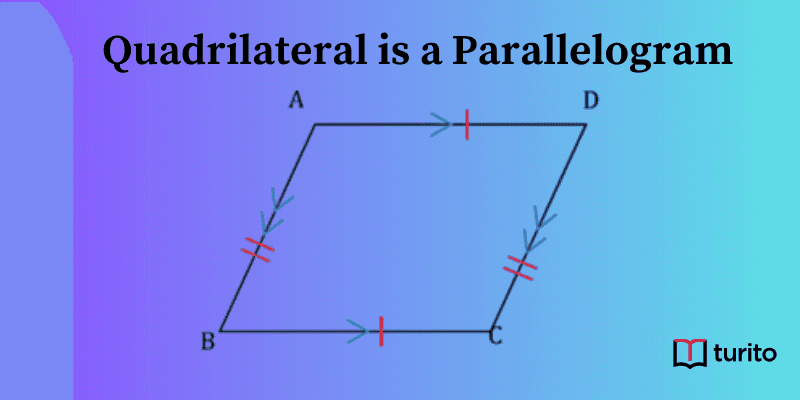
A simple quadrilateral in which the opposite sides are of equal length and parallel is called a parallelogram.

Real-life examples of a parallelogram
- Dockland office building in Hamburg, Germany.

- An eraser

- A striped pole
- A solar panel

Theorem
If one pair of opposite sides of a quadrilateral is parallel and congruent, then the quadrilateral is a parallelogram.

Given: WX=ZY
To prove: WXYZ is a parallelogram.
Proof: Now, in △XZY and △ZXW,

WX = ZY
∠WXZ = ∠XZY [Alternate interior angles]
XZ = ZX [Reflexive property]
So, △XZY ≅ △ZX by Side-Angle-Side congruence criterion
If two triangles are congruent, their corresponding sides are equal.
Hence, WZ=XY
Therefore,
WXYZ is a parallelogram.
Theorem
If an angle of a quadrilateral is supplementary to both of its consecutive angles, then the quadrilateral is a parallelogram.

Given: ∠A+∠B = 180° and ∠A+∠D = 180°
To prove: ABCD is a parallelogram.
Proof:
Given: ∠A and ∠B are supplementary.
If two lines are cut by a transversal, then the consecutive interior angles are supplementary, and the lines are parallel.
So, AD ∥ BC …(1)
Given: ∠A and ∠D are supplementary.
We know that if the consecutive interior angles are supplementary, then the lines are parallel.
So, AB ∥ CD …(2)
From (1) and (2), we get AB∥CD and AD∥BC
Hence,
ABCD is a parallelogram.
Theorem
If both the pairs of opposite sides of a quadrilateral are congruent, then the quadrilateral is a parallelogram.

Given: PQ=RS and PS=QR
To prove: PQRS is a parallelogram.
Proof:
Now, in △PQS and △RSQ,
PQ = RS
PS = RQ
QS = SQ [Reflexive property]
So, △PQS ≅ △RSQ by Side-Side-Side congruence criterion
If two triangles are congruent, their corresponding angles are equal.
Hence, ∠PQS = ∠RSQ and ∠QSP = ∠SQR
We know that if two lines are cut by a transversal, then the alternate interior angles are congruent, and the lines are parallel.
So, PQ ∥ SR and PS ∥ QR
Therefore,
PQRS is a parallelogram.
Theorem
If the diagonals of a quadrilateral bisect each other, then the quadrilateral is a parallelogram.

Given: LP=PN and OP=PM
To prove: LMNO is a parallelogram.
Proof:
Now, in
△OPN and △MPL, OP=MP
∠OPN=∠MPL [Vertically opposite angles]
PN=PL
So,
△OPN ≅ △MPL by Side-Angle-Side congruence criterion.
If two triangles are congruent, their corresponding sides are equal.
Hence,
ON = LM …(1)
And, in △LPO and △NPM,
LP = NP
∠LPO = ∠NPM [Vertically opposite angles]
PO = PM
So, △LPO ≅ △NPM by Side-Angle-Side congruence criterion.
If two triangles are congruent, their corresponding sides are equal.
Hence,
LO = MN …(2)
From (1) and (2), we get
ON = LM and LO = MN.
∴LMNO is a parallelogram.
Theorem
If both pairs of opposite angles of a quadrilateral are congruent, then the quadrilateral is a parallelogram.

Given: ∠A=∠C; ∠B=∠D
To prove: ABCD is a parallelogram.
Proof:
We know that the sum of angles of a quadrilateral is 360°.
So,
∠A+∠B+∠C+∠D=360°
∠A+∠B+∠A+∠B=360°
2(∠A+∠B) =360°
∠A+∠B=180°
If two lines are cut by a transversal, then the consecutive interior angles are supplementary, and the lines are parallel.
Since ∠A and ∠B are supplementary,
so, AD ∥ BC …(1)
Or we can write
∠A+∠B+∠C+∠D=360°
∠A+∠D+∠A+∠D=360°
2(∠A+∠D) =360°
∠A+∠D=180°
Since the angles ∠A and ∠D are supplementary, so,
AB ∥ CD …(2)
From (1) and (2), we get AB ∥ CD and AD ∥ BC
So, ABCD is a parallelogram.
Exercise
- For what values of x and y is the given quadrilateral a parallelogram?

- For what values of w and z is the given figure a parallelogram?

- Is the figure below a parallelogram?

- For what values of x and y is the given quadrilateral a parallelogram?

- Is the figure below a parallelogram?

Concept Map

What we have learned
- A quadrilateral whose two pairs of opposite sides are parallel is called a parallelogram.
- If a quadrilateral is a parallelogram, then its opposite sides are congruent.
- If a quadrilateral is a parallelogram, then its consecutive angles are supplementary.
- If a quadrilateral is a parallelogram, then opposite angles are congruent.
- If a quadrilateral is a parallelogram, then its diagonals bisect each other.
Related topics

Obtuse Angle: Definition, Degree Measure, and Examples
What is an Obtuse Angle? In geometry, an angle that is greater than 90 degrees but lesser than 180 degrees is called an obtuse angle. We can easily recognize an obtuse angle because it extends past a right angle. Obtuse angle explained in detail with examples but first learn about angles. Type of Angles Geometry […]
Read More >>
Line Segment in Geometry: Definition, Symbol, Formula, and Examples
A line is a straight, one-dimensional figure that extends endlessly in both directions in geometry. It has no starting and ending points. When we define a starting point but not an ending point of a line, it is called a ray. Another important term associated with the line is a line segment. Line Segment Definition […]
Read More >>Area of Irregular Shapes for Grade 3 – Simple Methods & Examples
What Is the Area of an Irregular Shape? The area of an irregular shape is the space that it occupies, although it does not follow a clean formula. In contrast to the squares or perfect rectangles, irregular shapes have sides that are uneven or their angles don’t line up evenly. That is what makes them […]
Read More >>
Addition and Multiplication Using Counters & Bar-Diagrams
Introduction: We can find the solution to the word problem by solving it. Here, in this topic, we can use 3 methods to find the solution. 1. Add using counters 2. Use factors to get the product 3. Write equations to find the unknown. Addition Equation: 8+8+8 =? Multiplication equation: 3×8=? Example 1: Andrew has […]
Read More >>

Other topics



Comments: