



Sine and Cosine Ratios

Key Concepts
- Find tangent ratios
- Find sine ratios
Apply the Tangent Ratio
- A trigonometric ratio is a ratio of the lengths of two sides in a right triangle. You will use trigonometric ratios to find the measure of a side or an acute angle in a right triangle.
- The ratio of the lengths of the legs in a right triangle is constant for a given angle measure. This ratio is called the tangent of the angle.
Tangent Ratio
Let ABC be a right triangle with acute ∠A. The tangent of ∠A (written as tan A) is defined as follows:


Tan A = Length of leg opposite ∠A / Length of leg adjustment to ∠A = BC / AC
Find tangent ratios
Example 1:
Find tan A and tan B. Write each answer as a fraction and as a decimal rounded to four places.

Solution:

Tan A = Length of leg opposite ∠A / Length of leg adjustment to ∠A = BC / AC
= 18 / 24
= 0.75
Tan B = Length of leg opposite ∠A / Length of leg adjustment to ∠A = BC / AC
= 24 / 18
= 1.33
Example 2:
Find the value of x.
Solution:
Use the tangent of an acute angle to find a leg length.
tan 25° = opp / adj (Write ratio for tangent of 25°)
tan 25° = x / 12 (Substitute)
12. tan 25° = x (Multiply each side by 12)
12.(0.4663) = x (Use a calculator to find tan 25°)
5.6 = x Simplify.

Example 3:
Kelvin is measuring the height of a Sitka spruce tree in North Carolina. He stands 45 feet from the base of the tree. He measures the angle of elevation from a point on the ground to the top of the tree to be 59°. How can he estimate the height of the tree?

Solution:
tan 59° = opp / adj
tan 59° = h / 45
45 ⋅ tan 59° = h
45 ⋅ 1.6643 = h (Simplify)
74.9 ≈ h
So, the tree is about 75 feet tall.
Apply the Sine and Cosine Ratios
The sine and cosine ratios are trigonometric ratios for acute angles that involve the lengths of a leg and the hypotenuse of a right triangle.
Sine and Cosine Ratios
Let ABC be a right triangle with acute ∠A. The sine of ∠A and cosine of ∠A (written sin A and cos A) are defined as follows:

Sin A = Length of leg opposite ∠A / Length of leg adjustment to ∠A = BC / AB
Cos A = Length of leg opposite ∠A / Length of leg adjustment to ∠A = AC / AB
Find sine ratios
Example 1:
Find sin X and sin Y. Write each answer as a fraction and as a decimal.

Solution:
Sin x = Length of leg opposite ∠X / Length of hypotenuse Length of leg opposite ∠X
opp.∠xhyp = zy / xy
= 817 ≈ 0.4706
Exercise
- Nick uses the equation sin 49 =x/16 to find BC in ABC. Robert uses the equation cos 41= x/16. Which equation produces the correct answer? Explain.

- Use a sine or cosine ratio to find the value of each variable. Round decimals to the nearest tenth.

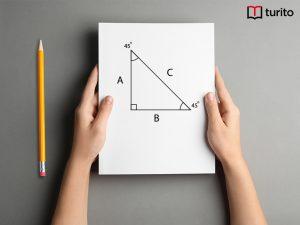
- Use the 45-45-90 Triangle Theorem to find the sine and cosine of a 45 angle.
- Finding sine ratios: Find sin D and sin E. Write each answer as a fraction and as a decimal. Round to four decimal places if necessary.

- You are looking at an eye chart that is 20 feet away. Your eyes are level with the bottom of the “E” on the chart. To see the top of the “E,” you look up 18. How tall is the “E”?

- Copy and complete the statement with <, >or =. Explain.

Concept Map

What have we learned
- Understand tangent ratio.
- Understand how to find tangent ratio.
- Find leg length.
- Estimate height using tangent
- Use a special right triangle to find a tangent
- Find sine and cosine ratios
- Use a special right triangle to find a sine and cosine.
Related topics

Obtuse Angle: Definition, Degree Measure, and Examples
What is an Obtuse Angle? In geometry, an angle that is greater than 90 degrees but lesser than 180 degrees is called an obtuse angle. We can easily recognize an obtuse angle because it extends past a right angle. Obtuse angle explained in detail with examples but first learn about angles. Type of Angles Geometry […]
Read More >>
Line Segment in Geometry: Definition, Symbol, Formula, and Examples
A line is a straight, one-dimensional figure that extends endlessly in both directions in geometry. It has no starting and ending points. When we define a starting point but not an ending point of a line, it is called a ray. Another important term associated with the line is a line segment. Line Segment Definition […]
Read More >>Area of Irregular Shapes for Grade 3 – Simple Methods & Examples
What Is the Area of an Irregular Shape? The area of an irregular shape is the space that it occupies, although it does not follow a clean formula. In contrast to the squares or perfect rectangles, irregular shapes have sides that are uneven or their angles don’t line up evenly. That is what makes them […]
Read More >>
Addition and Multiplication Using Counters & Bar-Diagrams
Introduction: We can find the solution to the word problem by solving it. Here, in this topic, we can use 3 methods to find the solution. 1. Add using counters 2. Use factors to get the product 3. Write equations to find the unknown. Addition Equation: 8+8+8 =? Multiplication equation: 3×8=? Example 1: Andrew has […]
Read More >>

Other topics



Comments: