



Triangle Inequality

Key Concepts
- Relating side length and angle measure.
- Triangle inequality.
- Possible side lengths.
Introduction
In the previous session, we learned about medians, centroid, altitudes, orthocenter, and special cases of an isosceles triangle.
In this session, you will learn about inequalities in a triangle, relating side lengths and angle measures, triangle inequality, and possible side lengths in a triangle.
Theorems
Theorem 1
If one side of a triangle is longer than the other side, then the angle opposite the longer side is larger than the angle opposite the shorter side.

Theorem 2
If an angle of a triangle is larger than another angle, then the side opposite the larger angle is longer than the side opposite the smaller angle.

Example 1:

Draw an acute-angled triangle and relate the side lengths and angle measures.
Solution:

Suppose a < b < c,
The angle opposite to the side a is the smaller angle,
The angle opposite to the side c is the larger angle.
∠C > ∠B > ∠A
Example 2:
In an obtuse-angled triangle ABC, find the larger angle and longer side.
Solution:

In the obtuse-angled angle triangle ABC, it is clear that
∠B is the obtuse angle,
The obtuse angle is the largest in the obtuse-angled triangle.
So, ∠B is the larger angle.
From theorem 2,
If an angle of a triangle is larger than another angle, then the side opposite the larger angle is longer than the side opposite the smaller angle.
The side opposite ∠B is the longer side.
Theorem 3
If a side of a triangle is longer than another side, then the angle opposite the longer side is larger than the angle opposite the shorter side.

Proof:
Given that PQ > PR
Now we prove that ∠PRQ > ∠PQR
Plot a point S on PQ such that PS = PR … (1)
In isosceles triangle ∠PSR = ∠PRS … (2)
∠PRQ = ∠PRS + ∠QRS … (3)
∠PRQ > ∠PRS
∠PRQ > ∠PSR … (4) (since from (2))
From the exterior angle theorem, ∠PSR = ∠PQR + ∠SRQ
Therefore ∠PSR > ∠PQR …(5)
From (4) and (5)
Finally, we conclude ∠PRQ > ∠PQR
Hence proved.
Triangle Inequality Theorem
Triangle Inequality
Every group of three segments cannot form a triangle.
It needs to fit certain relations.
Example:
If you draw the longest side as a base and connect the other two sides in the first and second figures, the triangle is not formed. This leads to the triangle inequality theorem.

Triangle Inequality Theorem
Theorem:
The sum of the lengths of any two sides of a triangle is greater than the third side.
AB + BC > AC,
AC + AB > BC,
AC + BC > AB.

Possible Side Lengths
Example:
In a triangle, one side is of length 12 cm, another side is of length 5. Find the possible side lengths.
Solution:

Let the third side of the triangle be x
Now x can be the smallest side or x can be the longest side.
We use the properties of the triangle inequality.
12 + 5 > x
17 > x
x + 5 > 12
x > 12 – 5
x > 7
x > 7 and x < 17.
The length of the third side is greater than 7 and less than 17.
Real-Life Example
In real life, the inequalities of a triangle are used mostly by civil engineers, as this involves so much in their work to find the unknown lengths of different dimensions.
Example:
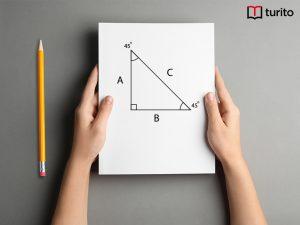
In a construction field, a triangular shape ABC must be constructed (as shown in the image), the left side of the triangle is 12 feet and the right side of the triangle is 13 feet, the base is 26 feet, one angle is
45° and another angle is 54° what will be the other angle in that triangle?
Solution:
Given, that the left side of the triangle is 12 feet, and the right side of the triangle is 13 feet, the base is 26 feet, one angle is
45° and another angle is 54°.
Since the sum of angles in a triangle = 180°
So,
180°−(45°+54°)
= 180° – 99°
= 81°
The other angle is 81°
Now the given theorem we have ∠BAC = 81°
This will be at the top, which is at A, as the base is the longest side.
Exercise
- Draw a triangle for side lengths 6, 8, and 10 units and mention the angles 30°, 60°, and 90°. Sketch the triangle and mark the angles.
- Mention the smaller side to the longer side from the given figure.

- If one side of a triangle is 11 cm and another side is 6 cm. Find the possible length of the third side.
- How can you say which angle is largest in a triangle?
- Mention the smaller angle to the larger angle from the given figure.

- Which group of lengths is used to form a triangle?
3, 4, 5
4, 2, 2
3, 2, 1
2, 2, 2
Q (7-10)

- From the above figure, what are the possible values of x?
- From the above figure, what are the possible values of PQ?
- From the above figure, what are the possible values of QR?
- From the above figure, what are the possible values of RP?
Concept Map

What we have learned
- Relating side lengths and angle measures.
- Triangle inequality.
- Possible side lengths.
Related topics

Obtuse Angle: Definition, Degree Measure, and Examples
What is an Obtuse Angle? In geometry, an angle that is greater than 90 degrees but lesser than 180 degrees is called an obtuse angle. We can easily recognize an obtuse angle because it extends past a right angle. Obtuse angle explained in detail with examples but first learn about angles. Type of Angles Geometry […]
Read More >>
Line Segment in Geometry: Definition, Symbol, Formula, and Examples
A line is a straight, one-dimensional figure that extends endlessly in both directions in geometry. It has no starting and ending points. When we define a starting point but not an ending point of a line, it is called a ray. Another important term associated with the line is a line segment. Line Segment Definition […]
Read More >>Area of Irregular Shapes for Grade 3 – Simple Methods & Examples
What Is the Area of an Irregular Shape? The area of an irregular shape is the space that it occupies, although it does not follow a clean formula. In contrast to the squares or perfect rectangles, irregular shapes have sides that are uneven or their angles don’t line up evenly. That is what makes them […]
Read More >>
Addition and Multiplication Using Counters & Bar-Diagrams
Introduction: We can find the solution to the word problem by solving it. Here, in this topic, we can use 3 methods to find the solution. 1. Add using counters 2. Use factors to get the product 3. Write equations to find the unknown. Addition Equation: 8+8+8 =? Multiplication equation: 3×8=? Example 1: Andrew has […]
Read More >>

Other topics



Comments: